What Makes a Website Actually Fast in 2026
Speed is not optional anymore
Google's Core Web Vitals are now a ranking factor. Users abandon pages that take more than 3 seconds to load. And on mobile — where most of your traffic comes from — every kilobyte matters.
We've built dozens of websites at Credosis. The ones that perform best share a few things in common that have nothing to do with raw server speed.
The real culprits behind slow websites
Most people assume slow websites are a hosting problem. Sometimes they are — but more often, the issue is in the code itself.
JavaScript bloat
The single biggest performance killer we see is unnecessary JavaScript. Every library you add has to be downloaded, parsed, and executed before your page becomes interactive. We audit every dependency we ship and ask: does this actually need to be on the client?
Next.js's server components have been a game-changer here. By running logic on the server and shipping only the rendered HTML, we dramatically reduce what the browser has to do.
Unoptimized images
Images are still the heaviest assets on most pages. We use:
- Next.js Image component for automatic WebP conversion and lazy loading
- Explicit width and height to prevent layout shift
- CDN delivery so images are served from the closest edge location
Render-blocking resources
Fonts, stylesheets, and scripts that block the initial render are invisible to most developers but devastating to performance. We load critical CSS inline, defer non-critical scripts, and use font-display: swap to prevent invisible text during font loading.
What we actually measure
Performance isn't a feeling — it's a number. We use three metrics to define success:
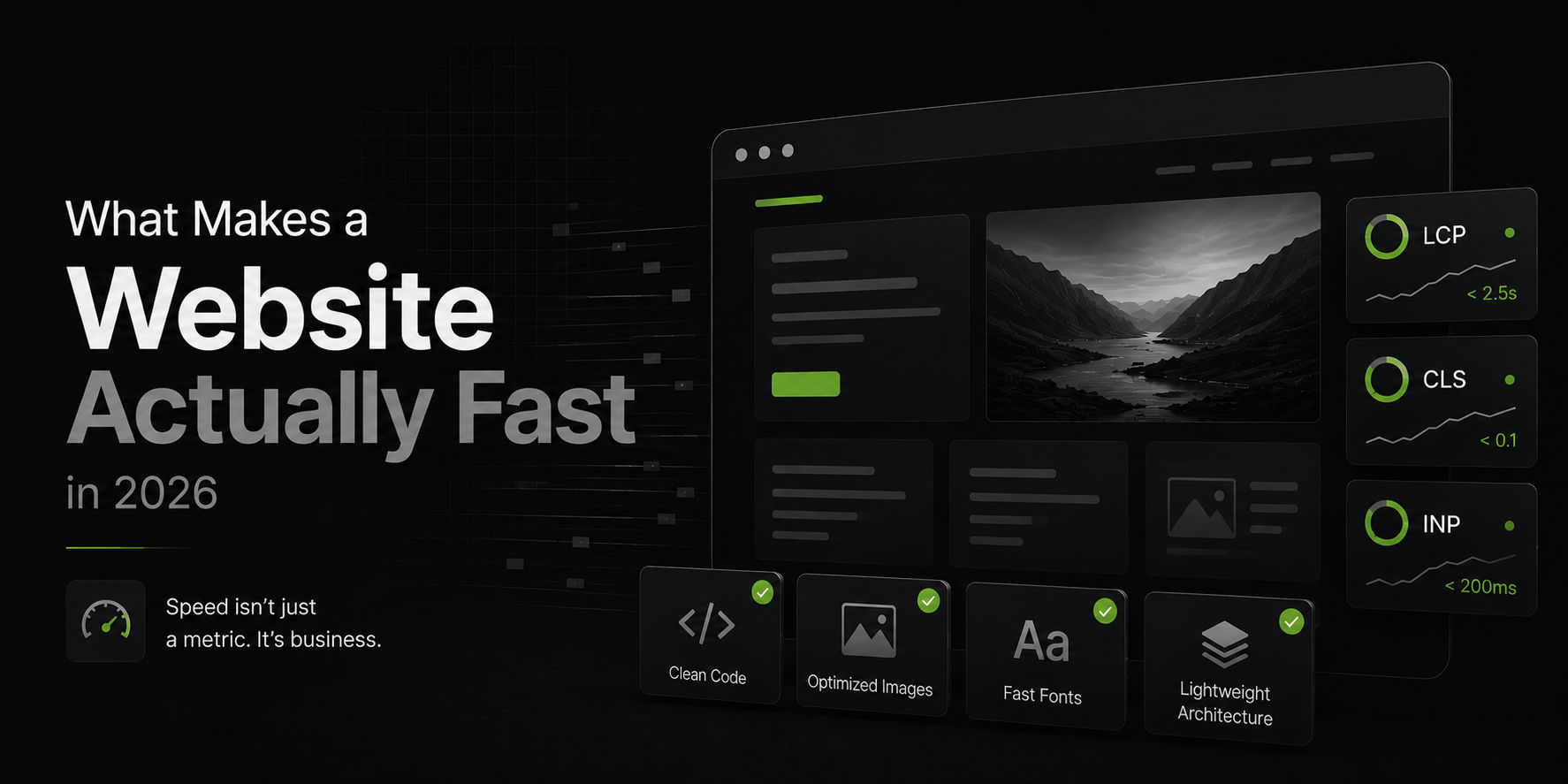
- Largest Contentful Paint (LCP) — how quickly the main content appears. Target: under 2.5 seconds.
- Cumulative Layout Shift (CLS) — how stable the page is as it loads. Target: under 0.1.
- Interaction to Next Paint (INP) — how responsive the page feels to interaction. Target: under 200ms.
These aren't arbitrary. They're what Google measures, and what users feel.
A note on frameworks
We build most of our client websites in Next.js. Not because it's trendy, but because it gives us precise control over what gets rendered where — server, client, or edge. That control directly translates to performance.
For simpler sites, we sometimes use static generation with no JavaScript at all. Fast by default.
Building a new website or improving an existing one? Talk to us — we're happy to run a free performance audit.